Class 8 Math: Chapter 1 Pattern step by step Solution
pattern, Class 8 Math PDF Download, Class 8 Math: Chapter 1 Pattern step by step Solution, Class 8 Math Chapter 1Pattern Formula, Sequence: 2, 5, 8, 11, 14, … Find the 10th term of this pattern.Examples from Chapter 1, Class 8 on Pattern, Formula of Pattern, Definition of Pattern for Class 8, and Geometric Pattern Explanation.
Pattern: A pattern is defined as a sample or model of something. Patterns are crafted in such a way that they can be used to make molds in damp sand for casting molten metal to create objects or items. Below are the 10 types of patterns:
1. Single-piece Pattern
2. Gate Pattern
3. Loose-piece Pattern
4. Split Pattern
5. Match Plate Pattern
6. Cope and Drag Pattern
7. Sweep Pattern
8. Left and Right Hand Pattern
9. Shell Pattern
10. Built-up Pattern
Exercise solution and creative question
(a) 1, 3, 5, 7, 9, …
Solution:
List of numbers: 1, 3, 5, 7, 9, …
Difference: 3 – 1 = 2, 5 – 3 = 2, 7 – 5 = 2, 9 – 7 = 2
So, the difference each time is 2.
Therefore, the next four numbers are:
9 + 2 = 11
11 + 2 = 13
13 + 2 = 15
15 + 2 = 17
Answer: 11, 13, 15, 17
(b) 4, 8, 12, 16, 20, …
Solution:
List of numbers: 4, 8, 12, 16, 20, …
Difference: 8 – 4 = 4, 12 – 8 = 4, 16 – 12 = 4, 20 – 16 = 4
So, the difference each time is 4.
Therefore, the next four numbers are:
20 + 4 = 24
24 + 4 = 28
28 + 4 = 32
32 + 4 = 36
Answer: 24, 28, 32, 36
(c) 5, 10, 15, 20, 25, …
Solution:
List of numbers: 5, 10, 15, 20, 25, …
Difference: 10 – 5 = 5, 15 – 10 = 5, 20 – 15 = 5, 25 – 20 = 5
So, the difference each time is 5.
Therefore, the next four numbers are:
25 + 5 = 30
30 + 5 = 35
35 + 5 = 40
40 + 5 = 45
Answer:30, 35, 40, 45
(d) 7, 14, 21, 28, 35, …
Solution:
List of numbers: 7, 14, 21, 28, 35, …
Difference: 14 – 7 = 7, 21 – 14 = 7, 28 – 21 = 7, 35 – 28 = 7
So, the difference each time is 7.
Therefore, the next four numbers are:
35 + 7 = 42
42 + 7 = 49
49 + 7 = 56
56 + 7 = 63
Answer: 42, 49, 56, 63
(e) 8, 16, 24, 32, 40, …
Solution:
List of numbers: 8, 16, 24, 32, 40, …
Difference: 16 – 8 = 8, 24 – 16 = 8, 32 – 24 = 8, 40 – 32 = 8
So, the difference each time is 8.
Therefore, the next four numbers are:
40 + 8 = 48
48 + 8 = 56
56 + 8 = 64
64 + 8 = 72
Answer: 48, 56, 64, 72
(f) 6, 12, 18, 24, 30, …
Solution:
List of numbers: 6, 12, 18, 24, 30, …
Difference: 12 – 6 = 6, 18 – 12 = 6, 24 – 18 = 6, 30 – 24 = 6
So, the difference each time is 6.
Therefore, the next four numbers are:
30 + 6 = 36
36 + 6 = 42
42 + 6 = 48
48 + 6 = 54
Answer: 36, 42, 48, 54
2. Find the difference between each pair of terms in each sequence and determine the next two numbers:
(a) 7, 12, 17, 22, 27, …
(b) 6, 17, 28, 39, 50, …
(c) 24, 20, 16, 12, 8, …
(d) –5, –8, –11, –14, …
(e) 14, 9, 4, –1, –6, …
(f) 11, 8, 5, 2, –1, …
(a) 7, 12, 17, 22, 27, …
Solution:
List of numbers: 7, 12, 17, 22, 27, …
Difference: 17 – 12 = 5, 22 – 17 = 5, 27 – 22 = 5
So, the difference each time is 5.
Therefore, the next two numbers are:
27 + 5 = 32
32 + 5 = 37
Answer: 32, 37
(b) 6, 17, 28, 39, 50, …
Solution:
List of numbers: 6, 17, 28, 39, 50, …
Difference: 17 – 6 = 11, 28 – 17 = 11, 39 – 28 = 11, 50 – 39 = 11
So, the difference each time is 11.
Next two numbers:
50 + 11 = 61
61 + 11 = 72
Answer: 61, 72
(c) 24, 20, 16, 12, 8, …
Solution:
List of numbers: 24, 20, 16, 12, 8, …
Difference: 24 – 20 = 4, 20 – 16 = 4, 16 – 12 = 4, 12 – 8 = 4
So, the difference each time is -4.
Next two numbers:
8 – 4 = 4
4 – 4 = 0
Answer: 4, 0
(d) 11, 8, 5, 2, –1, …
Solution:
List of numbers: 11, 8, 5, 2, –1, …
Difference: 11 – 8 = 3, 8 – 5 = 3, 5 – 2 = 3, 2 – (-1) = 3
So, the difference each time is -3.
Next two numbers:
-1 – 3 = -4
-4 – 3 = -7
Answer: -4, -7
(e) –5, –8, –11, –14, …
Solution:
List of numbers: –5, –8, –11, –14, …
Difference: -8 – (-5) = -3, -11 – (-8) = -3, -14 – (-11) = -3
So, the difference each time is -3.
Next two numbers:
-14 – 3 = -17
-17 – 3 = -20
Answer: -17, -20
(f) 14, 9, 4, –1, –6, …
Solution:
List of numbers: 14, 9, 4, –1, –6, …
Difference: 14 – 9 = 5, 9 – 4 = 5, 4 – (-1) = 5, -1 – (-6) = 5
So, the difference each time is -5.
Next two numbers:
-6 – 5 = -11
-11 – 5 = -16
Answer: -11, -16
3. Find the next two numbers in the sequence:
(a) 2, 2, 4, 8, 14, 22, …
(b) 0, 3, 8, 15, 24, …
(c) 1, 4, 10, 22, 46, …
(d) 4, –1, –11, –26, –46, …
(a) 2, 2, 4, 8, 14, 22, …
Solution:
Given sequence: 2, 2, 4, 8, 14, 22, …
Differences: 0, 2, 4, 6, 8
Each difference increases by a multiple of 2.
According to this, the next two differences will be 10 and 12.
So, the next two numbers are:
22 + 10 = 32
32 + 12 = 44
Answer: 32, 44
(b) 0, 3, 8, 15, 24, …
Solution:
Given sequence: 0, 3, 8, 15, 24, …
Differences: 3, 5, 7, 9
Each difference increases by 2.
So, the next two numbers are:
24 + 11 = 35
35 + 13 = 48
Answer: 35, 48
(c) 1, 4, 10, 22, 46, …
Solution:
Given sequence: 1, 4, 10, 22, 46, …
Differences: 3, 6, 12, 24
Each difference doubles each time.
So, the next two differences will be 48 and 96.
The next two numbers are:
46 + 48 = 94
94 + 96 = 190
Answer: 94, 190
(d) 4, –1, –11, –26, –46, …
Solution:
Given sequence: 4, –1, –11, –26, –46, …
Differences: –5, –10, –15, –20
Each difference decreases by a multiple of 5.
So, the next two differences will be –25 and –30.
The next two numbers are:
–46 – 25 = –71
–71 – 30 = –101
Answer: –71, –101
4. Do the following number patterns have any similarities? Find the next number in each sequence.
(a) 1, 1, 2, 3, 5, 8, 13, …
(b) 4, 4, 5, 6, 8, 11, …
(c) –1, –1, 0, 1, 3, 6, 11, …
(a) 1, 1, 2, 3, 5, 8, 13, …
Solution:
Given sequence: 1, 1, 2, 3, 5, 8, 13, …
Differences: 0, 1, 1, 2, 3, 5
Pattern: The first two numbers are the same, and the sequence follows a pattern where the sum of two consecutive numbers equals the next number, like 1 + 2 = 3.
Therefore, the next number in the sequence is: 8 + 13 = 21.
(b) 4, 4, 5, 6, 8, 11, …
Solution:
Given sequence: 4, 4, 5, 6, 8, 11, …
Differences: 0, 1, 1, 2, 3
Pattern: The first two numbers are the same, and the differences follow a sequence where the sum of two consecutive differences equals the next difference.
So, the next difference is: 3 + 2 = 5
Therefore, the next number in the sequence is: 11 + 5 = 16.
(c) –1, –1, 0, 1, 3, 6, 11, …
Solution:
Given sequence: –1, –1, 0, 1, 3, 6, 11, …
Differences: 0, 1, 1, 2, 3, 5
Pattern: The first two numbers are the same, and the differences follow a sequence where the sum of two consecutive differences equals the next difference.
Accordingly, the next difference is: 3 + 5 = 8
Therefore, the next number in the sequence is: 11 + 8 = 19
5. The following numbers were obtained from a computer program:
1, 2, 4, 8, 11, 16, 22
If one of these numbers is changed, they will form a pattern. Identify the number and replace it with the appropriate number.
Solution:
Given sequence: 1, 2, 4, 8, 11, 16, 22
Differences: 1, 2, 4, 3, 5, 6
Observing the differences, we can see that the 3rd and 4th differences (4 and 3) disrupt the pattern. If we switch the differences to 3 instead of 4 and 4 instead of 3, a pattern is created.
Thus, replacing the 4th number 8 with 7 (4 + 3 = 7) aligns the pattern.
Corrected sequence: 1, 2, 4, 7, 11, 16, 22
New differences: 1, 2, 3, 4, 5, 6
So, the correct number is 7.
6. Create the table of the number pattern using algebraic expressions.
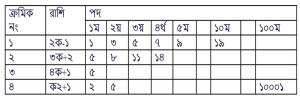
Solution:
Below, the table of the number pattern is created using algebraic expressions:

7. The following geometric shapes are made with sticks.

(a) What is the list of the number of sticks?
(b) Explain how to find the next number in the list.
(c) Create the next shape with sticks and verify your answer.
Solution:
(a) List of the number of sticks: 4, 7, 10
(b) Next number in the list: Given list: 4, 7, 10
Difference: 3, 3
The difference each time is 3.
So, the next number: 10 + 3 = 13
(c) Next shape:

Observing the given pattern made with sticks, it appears that a rectangular column is added each time. This column connects to the previous shape in such a way that the rightmost stick of the previous shape now functions as the left side of the new shape. This means that instead of adding 4 sticks each time, only 3 sticks are added to create each new shape. Therefore, by adding 3 sticks each time, the next shape is created, and this constructed geometric shape is correct.
8. The following triangles are created with matchstick patterns.
(a) Find the number of matchsticks in the fourth pattern.
(b) Explain how to find the next number in the sequence.
(c) How many matchsticks are needed to create the hundredth pattern?
Solution:
(a) The fourth pattern is:
From the diagram, it can be seen that the fourth pattern has 9 matchsticks.
(b) Given sequence of numbers: 3, 5, 7
Difference: 2, 2
So, the next number is: 7 + 2 = 9
(c) Given sequence of numbers: 3, 5, 7
Difference: 2, 2
The algebraic expression for this pattern is: 2n + 1
Here, ‘n’ is the pattern number.
Therefore, the number of matchsticks needed to create the hundredth pattern = 2 * 100 + 1 = 201
Creative Questions:
1. 4, 7, 10, 13, … is a number pattern.
(a) Express 325 as the sum of two squares in three different ways.
(b) Determine the algebraic expression for the sequence.
(c) Find the sum of the first 10 terms of the pattern excluding the first term.
2. 1, 4, 9, 16, 25, … is a number pattern.
(a) Write the formula for the sum of consecutive natural numbers.
(b) Determine the next three terms in the sequence.
(c) Find the sum of the first 20 differences in the sequence.
3. 1, 1, 2, 3, 5, 8, 13, … is a pattern, and (2n + 1) is an algebraic expression.
(a) What is a Fibonacci number? Explain.
(b) Determine the next four terms in the number pattern.
(c) Find the sum of the first 50 terms of the algebraic expression.
4. 5, 13, 24, 38, 55, … is a number pattern.
(a) Construct a 4×4 magic square using any suitable method.
(b) Find the next four terms in the sequence and calculate their sum.
(c) Develop a general formula to find any term in the pattern formed by the differences of the sequence, and find the sum of the first 50 terms.
5.7, 16, 25, 34, 43, … is a number pattern.
(a) Express the third and fourth numbers as the sum of two squares.
(b) Determine the common difference in the sequence and find the next three numbers.
(c) Find the 45th term and the sum of the first 45 terms in the sequence.
6. 5, 13, 21, 29, 37, …
(a) Express 29 and 37 as the sum of two squares.
(b) Determine the next four numbers in the sequence.
(c) Find the sum of the first 50 numbers in the sequence.
7. 7, 11, 15, 19, 23, 27, … is a number pattern.
(a) Express 40 as the difference of two squares and 100 as the sum of two squares.
(b) Show the rule by which the numbers in the pattern follow, and express a general formula for any term using variable n.
(c) Find the sum of the first 25 terms in the sequence.
8.(5n + 7 is an algebraic expression, where n is a natural number.
(a) Find the 1st and 2nd terms of the expression.
(b) Based on the prompt, draw the geometric pattern of the first three terms and determine the total number of line segments.
(c) Find the sum of the first fifty terms of the expression using a formula.
9. 3n + 1 is an algebraic expression for a number sequence.
(a) Express 325 as the sum of two squares in two different ways.
(b) Based on the prompt, draw the geometric pattern for the 3rd and 4th terms and verify the drawing.
(c) Find the sum of the first 100 terms of the expression.
10. (5n + 2) is an algebraic expression.
(a) What are the 1st and 2nd terms of the expression?
(b) Based on the prompt, draw the geometric pattern for the 3rd and 4th terms and verify the drawing.
(c) Find the sum of the first 100 terms of the expression.
